Interview
We conducted the following interview with Carlo Krone in September 2026 on the occasion of his solo exhibition at our gallery and the presentation of his works at the Armory Show in New York.
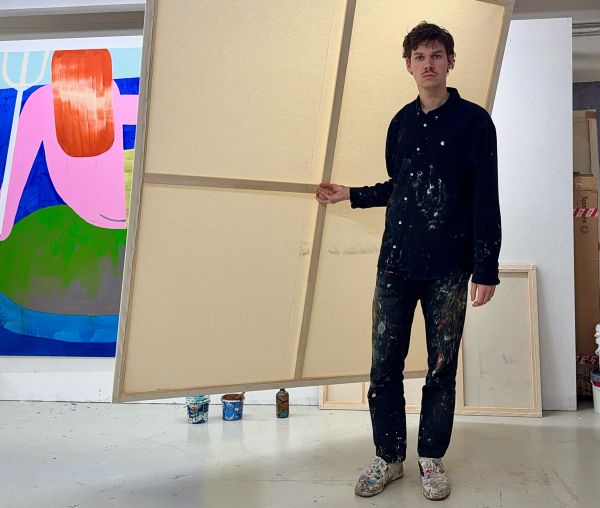
You graduated this summer. How does it feel to be working outside the context of the academy for the first time? Has it changed the way you look at your own work?
Carlo Krone: I already had the privilege of working and exhibiting outside the context of the academy while I was still studying. It feels great to be able to carry on more or less as before. The only difference is that my train ticket is more expensive now.
Did you always want to become an artist?
CK: No. At most in the same way a child might say they want to be a pirate or a princess when they grow up.
You are opening your solo exhibition "Freischwimmer" (in German: 'free swimmer' = to break free from something) shortly after graduating. Does the title also relate to this personal transition for you?
CK: Yes, it seemed quite fitting. I never earned a swimming certificate myself, not even the 'Seepferdchen' [Germany’s beginner swimming badge]. At least now I have a college degree.
You have said that with the new works, you want to “swim free” from familiar ways of working. What exactly do you want to free yourself from?
CK: I don’t really have anything specific in mind. Rather than leaving familiar ways of working behind, I’m more concerned with being open to new things. I see my own painterly methods as a kind of toolbox that can constantly be expanded. I feel that, as a painter, I circle around my subjects and approach them from all sides, using new means each time. It’s important to me to make it clear that this isn’t tied to specific colors, motifs, or styles. It’s about being in motion.
At the same time, it's important to you that your paintings remain recognizable as your own. How much change can your own approach withstand?
CK: I believe that my own approach can withstand quite a lot of change. It needs to be updated regularly, otherwise I get bored and the whole thing loses its sense of urgency. To what extent that actually affects the outward appearance of my work is another question. I may be a little too close to it myself to judge. After all, recognizability is only partly my job; it also requires viewers who are willing to look closely and recognize things again. I admire artists whose work has looked very different over the course of their careers.
Is there anything in the works for "Freischwimmer" that you wouldn't have done one or two years ago?
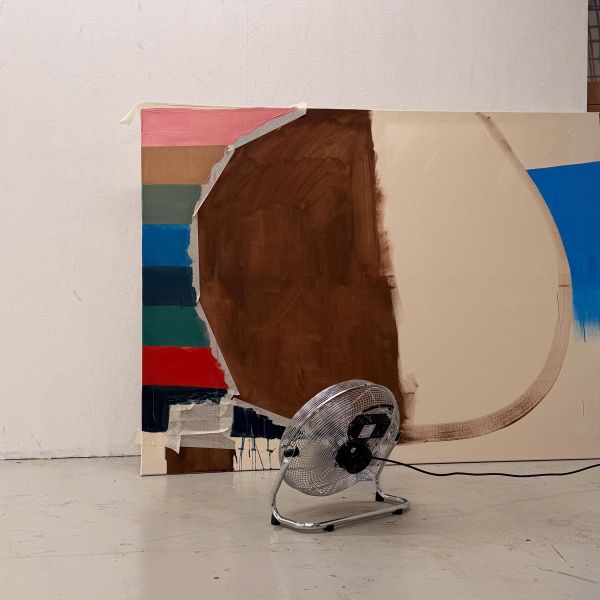
CK: A lot! The works are much more improvised and, at the same time, sometimes take longer than they used to. This leads to new kinds of overpainting and incompleteness, but also, in some cases, to a more muted color palette. Gestures and lines have also become more important. In general, I’d say that during the process I let the paintings guide me more, wherever they happen to want to go. This results in greater thematic and painterly diversity, but also creates new connections between the paintings.
You now work largely without preliminary sketches. When do you know which direction a painting should take - and when do you know that it's finished?
CK: Omitting such planning steps is one of the strategies that keeps the creative process open for longer. If you don’t have a sketch to stick to, then virtually anything is possible in the painting right up until the very end - day can still turn into night, entire figures can be added or erased, and minor details can suddenly take on central importance in the painting.
The way I place elements in my paintings has a lot to do with enumeration. It's a bit like playing Battleship: four small boats, three medium-sized ones, two larger ones and one big battleship. At some point, I have placed all my elements within the pictorial space and it's "full". So my paintings often have a kind of natural ending. At that point, I can still adjust the elements that are already there, but I can't keep adding things indefinitely.
You often talk about the "path of least resistance". What does that mean to you specifically when you're painting?
CK: For me, it means working in a straightforward and pragmatic way. Being spontaneous, adapting to the circumstances, reacting without overthinking, riding the wave. Maximum precision through the simplest possible execution. Here, “resistance” refers specifically to the physical act of painting. Of course, there are inner forms of resistance too. I think those are actually very healthy. Choosing the path of least resistance in that area, however, would be disastrous.
How do you deal with a painting taking a completely different direction from what you expected? Are there decisions you deliberately leave in place precisely because they initially seem "wrong", or do you also discard ideas?
CK: I let it happen. Basically, that's exactly what I want. That doesn't mean I don't sometimes get frustrated and feel sorry for myself when something isn't working. Not every new direction a painting takes is automatically brilliant. Sometimes I learn to love small mishaps over time. Or I adjust the context so that they look intentional. In music, they often say that if you play a wrong note, it’s best to just play it again right away.
Of course, I don't always manage to respond to mishaps with absolute wisdom and calm. Sometimes you just want something to work, so you get impatient and try to force it. If I ever paint a picture to death, I turn it upside down and paint a new one over it.
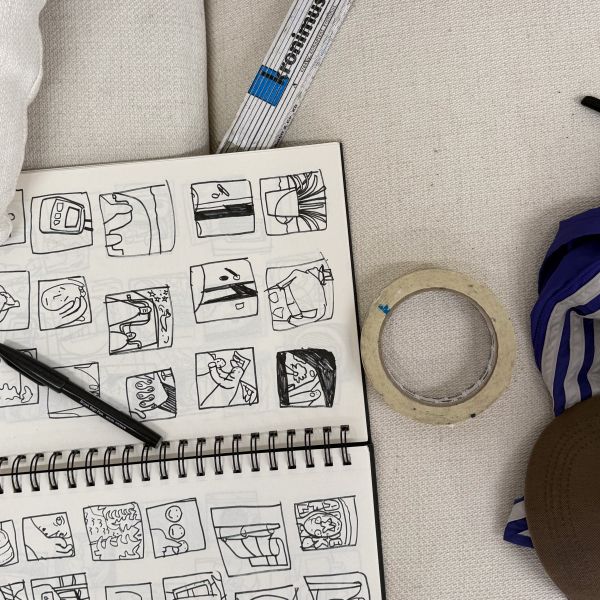
Many of your motifs are surprisingly ordinary or casual. What has to catch your attention in a situation for you to think: this could become a painting?
CK: It's hard to break that down, because it's not always rational and the way I arrive at an image can vary quite a bit. Sometimes I have a specific painterly idea in mind and look for a motif that can serve as the “arena” for it. In such cases, it’s best if nothing else in the image distracts from it - that’s why mundane things work very well. It’s also helpful if the image’s subject matter is accessible to as many people as possible. I like the challenge this creates: the more mundane and familiar the motif, the more you have to deliver on another level to be convincing.
Your paintings and titles often contain humor without coming across as punchlines. What role does humor play for you when you paint?
CK: On the one hand, there's something like a visual joke that arises when expectations are subverted and things are visually exaggerated.
More generally, I think humor as an attitude is extremely important in art. When artworks and the artists behind them immediately signal to me as a viewer just how important and serious they are, I usually want to leave straight away. I consider the idea that humor and lightness are incompatible with depth, artistic ambition or relevance is a fatal misconception. For me, my work is play - yet at the same time, I take what I do dead seriously. Lightness and carelessness are not the same thing.
You once said in conversation: “You can make things more appealing through perspective.” What do you mean by that?
CK: As a figurative painter, I depend on being genuinely interested in what I'm painting. Otherwise, the paintings turn out poorly. Often, it's not the actual subject of the painting that interests me, but how I approach it. How do you fit Santa Claus in a chimney into a small, square painting? How do you organize a complex scene so that it becomes a stable composition? I have complete freedom in that respect. Often, this approach allows me to breathe new life into motifs that aren’t inherently exciting. A Jesus on the cross seen from the front might seem boring and familiar. Painting him centrally from above, on the other hand, can suddenly become incredibly challenging and worthy of a painting.
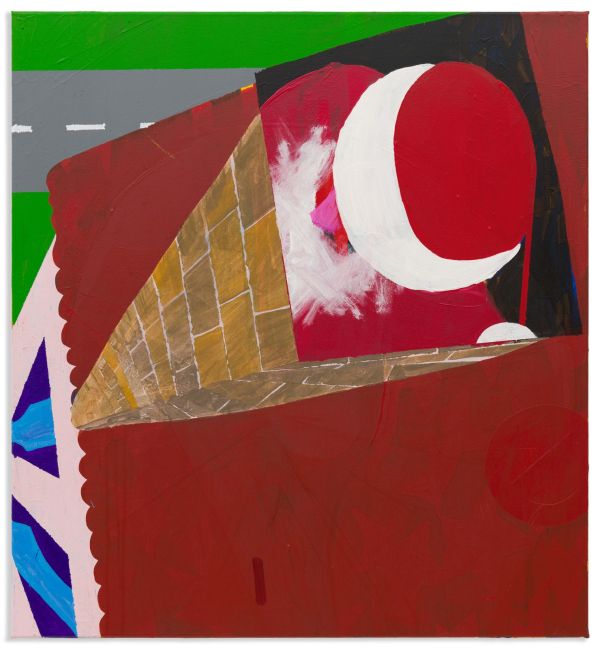
In your paintings, you deliberately bring together things that initially seem contradictory - bright and dirty colors, rough and precise brushwork, everyday life and art history. What interests you about this "clash"?
CK: I think it corresponds quite closely to the way I look at the world, or rather the way the world acts on me. It's fragmented, contradictory and at times extreme. That isn't some great revelation - artists were already exploring this 50 years ago, and today I'm sure most people feel something similar. What I mean is: I orchestrate and create this clash on the canvas; though not actually to produce something as extreme as possible, but to get a little closer to what corresponds to my experience of the world. That sounds deeper than it is. I don’t really think about it that actively while I’m working. Ultimately, I'm looking for the right painterly translation for each subject in the painting.
You once said: “In the end, every kind of painting is a form of trickery anyway.” What do you see as the trickery in painting?
CK: I feel there's still a great deal of mysticism surrounding painting. Personally, I really enjoy that romantic idea of painting. In my experience, though, the day-to-day work in the studio is often very rational. Anyone who paints ultimately wants to convince someone of something. Whatever that may be. Everyone has their own methods and ways of working and knows what works and what doesn’t when painting; we all have our own little tricks. It's a very down-to-earth process. The fact that, in the end, this sometimes still gives rise to something like magical moments - ones that are hard to describe in words - is what I find beautiful about painting.
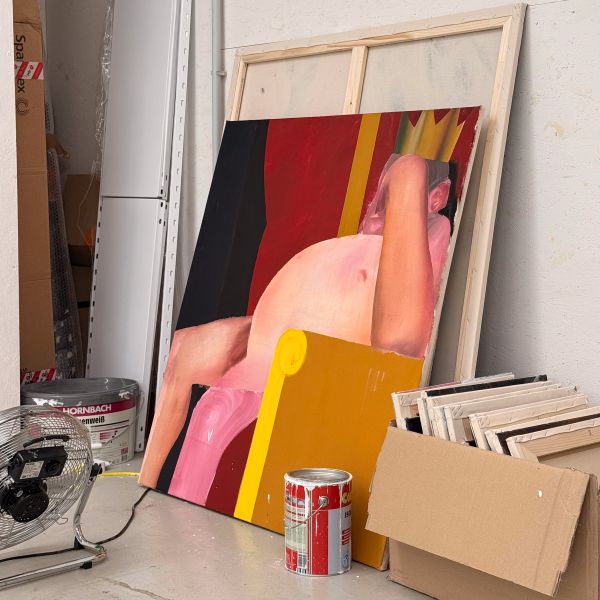
In September, your work will be shown in for the first time in New York at The Armory Show. What does that mean to you?
CK: The words “New York” alone obviously carry a certain aura. Even people outside the art world immediately understand that this is something special when you tell them about it. More than anything, I'm looking forward to seeing the city and its art - I have never been outside Europe before.
Does The Armory Show also feel like a special situation for you because so many people there will be encountering your work for the first time?
CK: Yes, it's always exciting to be able to show your work in a place where no one knows you yet. Of course, I’m very aware that with my paintings, I’ll be just a tiny speck of sand in this huge circus. I’d be very interested to see how my painting comes across through an American view - how German, or rather European, it actually is. That's something you can't really judge for yourself.
You've graduated, have a solo exhibition underway, and you're in New York - do you feel like you're at a turning point right now, or is that not something you think about much while working?
CK: First and foremost, it’s obviously an incredibly amazing and privileged situation to have so much coming up right after graduation. At the same time, I feel like I’m actually just starting from scratch now, even if that’s not entirely true.